How Do Detergent Powder Ingredients Affect Cleaning?
The performance of laundry detergent depends on more than the amount of cleaning ingredients used. The balance between surfactants, builders, enzymes, bleaching agents, anti-redeposition ingredients, and other additives determines how effectively dirt is released, suspended, and removed from fabric. Understanding these ingredients helps explain why different detergent powder formulas can produce different washing results.
Surfactants Start the Cleaning Process
Surfactants are the primary cleaning agents in most detergent powder formulations. They help water spread across fabric and interact with oily or particulate soils, allowing dirt to detach and remain dispersed in the wash water. For washing powder, surfactant selection is especially important because different soil types require different cleaning mechanisms. Anionic and nonionic surfactants are commonly combined to balance soil removal, emulsification, foam behavior, and washing conditions. A well-designed washing powder therefore relies on ingredient compatibility rather than one cleaning component working alone.
Builders Improve Performance in Hard Water
Water hardness can reduce detergent efficiency because calcium and magnesium ions interfere with surfactant activity. Builders help address this problem by binding or exchanging these minerals and supporting the cleaning system. They can also help disperse soils and reduce their tendency to redeposit on fabrics. This makes builders a critical part of laundry powder. In regions with harder water, an appropriately balanced laundry powder formula can maintain more consistent cleaning performance. Ingredients such as zeolites, citrates, and other builder systems can be selected according to formulation requirements and environmental considerations.
Enzymes Target Specific Stains
Enzymes give modern detergent powder formulations another level of cleaning ability. Proteases can target protein-based stains, while amylases and lipases are designed for starch- and fat-related soils. Because enzymes work selectively, they can complement rather than replace surfactants. For powder laundry detergent, enzyme stability is particularly important during storage. The formula must protect enzyme activity while keeping the powder physically stable. The right combination can improve stain removal without simply increasing the overall detergent dosage.
Bleaching Agents Address Difficult Colored Stains
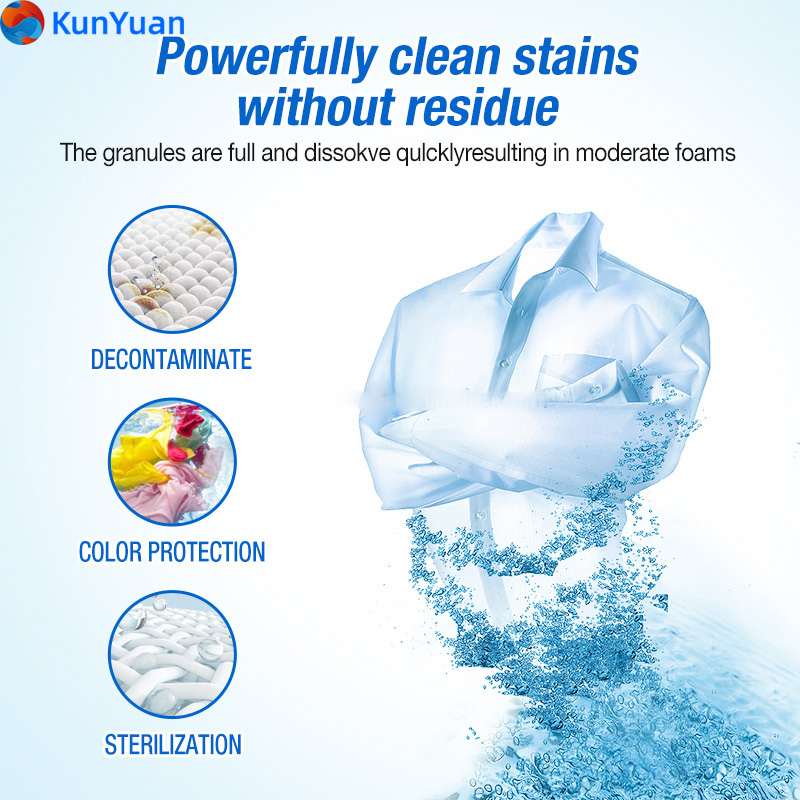
Some stains remain visible even after surfactants and enzymes have loosened the soil. Oxygen-based bleaching systems can help break down colored organic residues and improve the appearance of fabrics. In laundry powder, bleaching ingredients are often incorporated as part of a broader cleaning system rather than used independently. The effectiveness of powder laundry detergent therefore depends on how bleaching agents interact with surfactants, builders, enzymes, and washing conditions. Formulators need to balance stain removal with fabric compatibility and product stability.

detergent powder

washing powder

powder laundry detergent
laundry powder
Anti-Redeposition Ingredients Keep Fabrics Cleaner
Removing dirt is only part of successful washing. If loosened particles return to the fabric during the wash cycle, clothes may appear dull or gray over time. Anti-redeposition agents help keep suspended soil from settling back onto textile fibers. This function is especially valuable in washing powder used for heavily soiled loads. A complete laundry powder system therefore needs to consider both soil release and soil suspension. This two-stage approach can produce more consistent results across different fabrics and wash cycles.
Natural Formulas Require Careful Ingredient Selection
Interest in natural washing powder is increasing as consumers pay more attention to ingredient sources and environmental considerations. However, a natural washing powder still needs effective cleaning chemistry. Plant-derived or mineral-based ingredients must be selected according to their actual cleaning function, stability, water compatibility, and performance.
The concept of natural washing powder is therefore broader than simply replacing synthetic ingredients. A well-designed formula should consider the complete ingredient system and how each component contributes to cleaning.
Formulation Balance Shapes Final Performance
The most effective detergent powder is not necessarily the one containing the largest quantity of any single ingredient. Surfactants, builders, enzymes, bleaching systems, and anti-redeposition agents must work together under realistic water temperature, hardness, fabric load, and dosage conditions. Research also confirms that detergent performance can vary with washing conditions and water hardness.
For manufacturers such as Hainan Kunyuan Life Technology Co., Ltd, understanding these relationships can support the development of different washing powder, laundry powder, and powder laundry detergent solutions for specific market requirements.
The Future of Powder Detergent
Future powder laundry detergent development is likely to focus on concentrated formulas, efficient stain targeting, improved enzyme stability, responsible builder selection, and lower-temperature washing. Instead of relying on a single powerful ingredient, manufacturers are increasingly treating detergent as a coordinated system. The cleaning performance of detergent powder and natural washing powder depends on formulation balance. When each ingredient performs a clearly defined role and works effectively with the others, the result can be a more reliable and efficient laundry solution.
Hainan Kunyuan Life Technology Co., Ltd. owns a one-stop service platform, Rihua Cloud, which connects the best resources and capabilities under the empowerment and guidance of the government and industry associations, and provides one-stop services for daily chemical companies. Rihua Cloud offers five core services: procurement transactions, OEM/ODM, channel operations, digital solutions, and supply chain finance, to help companies solve operational problems, improve quality and efficiency, achieve sustainable growth, and promote industrial upgrading and high-quality development in the daily chemical industry.